
Spine Transform Constraint Erases Keyed Rotation: Check Relative
Use two keyed angles to tell whether a Spine transform constraint matches its target or adds to existing motion.
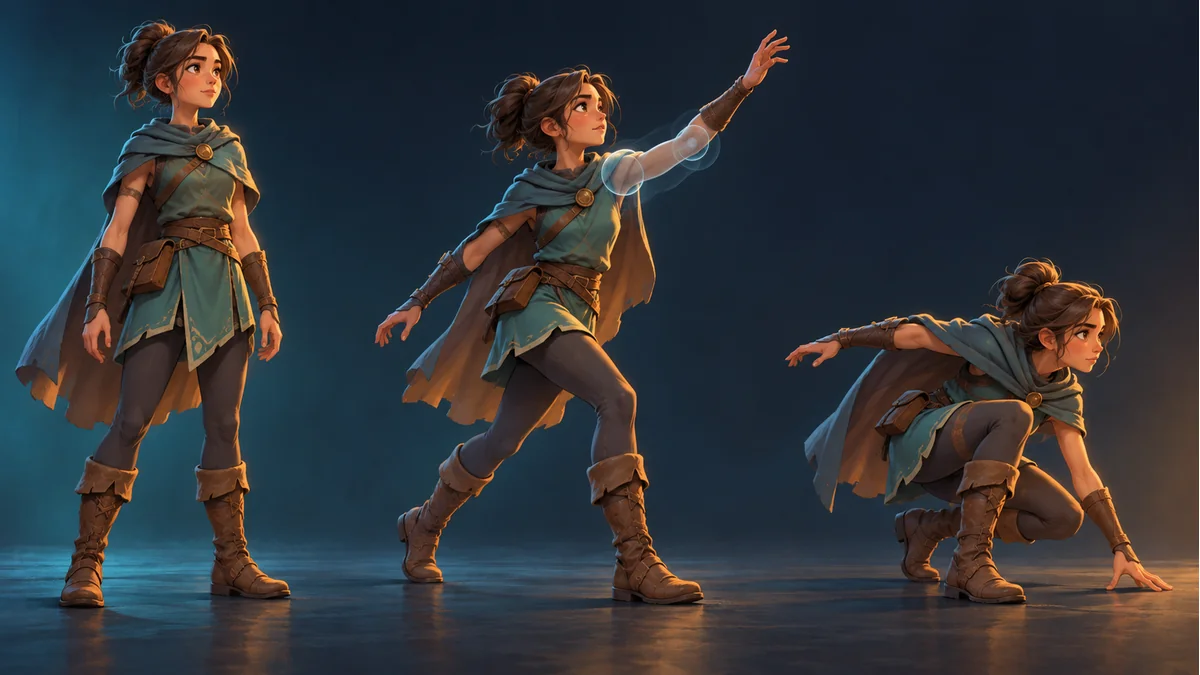
A cape clasp has two distinct keyed angles before the follow constraint is enabled. With rotation follow on, the frames look identical. Ask the shot owner whether the clasp must lock to a target heading or preserve its pose changes while picking up the control bone’s movement.
Keep the target steady for both frames
Use a copy of the rig. Pick one constrained bone and two frames with different source angles. Lock the space setting, disable unrelated mixes, and set rotation offset to zero. Record both source angles with rotation mix at zero, then repeat at full rotation mix with Relative off and on. The official Spine guide explains the role of each of those settings.
In a simple, unflipped test with a common angle reference, take source angles of 10° and 30° and a fixed target of 20°. A full match gives 20° on both frames. Adding the target gives 30° and 50°, preserving the original 20° difference. Treat that calculation as a control case and measure the production rig in its actual reference space.
Bring the complicated conditions back one by one
Once the isolated test is clear, check both facing directions. The guide warns that negative target scale can change the effective world rotation with world-space relative behavior. Capture the target orientation and facing state before changing either Local or Relative. Change one setting per comparison.
If the discrepancy returns when another constraint is enabled, keep the baseline captures and run the related diagnostic guide. When it only appears during the transition, record the actual mix on the affected frame and the neighboring poses.
Share the expected angles with the export
Record each frame, pre-constraint angle, target direction, chosen mode, mix, and observed angle. Review compatible exported assets in the Spine Workbench. Use the Spine editor and your target runtime to verify the constraint itself.
Ready to try "Spine Transform Constraint Erases Keyed Rotation: Check Relative"?
Use our online tools to apply this tutorial to your indie game project right away.